ABSTRACT
Differential diagnosis of left ventricular hypertrophy
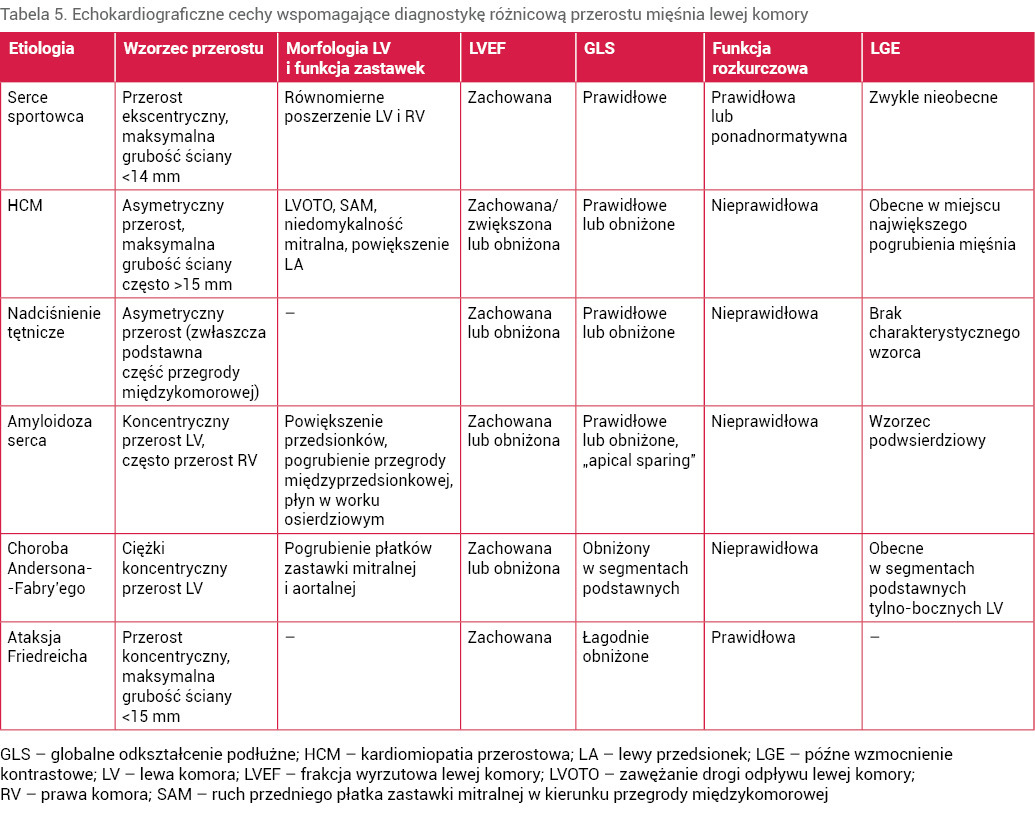
Left ventricular hypertrophy (LVH) is a common finding in cardiology and may represent either a physiological adaptation or a manifestation of an underlying cardiovascular disease. Echocardiography and cardiac magnetic resonance (CMR) enable a detailed assessment of left ventricular structure, function, and tissue characteristics, thus facilitating an accurate differentiation between physiological and pathological hypertrophy. Echocardiography remains the first-line modality for identifying LVH, evaluating wall thickness, left ventricular mass index, relative wall thickness, systolic and diastolic function, and hemodynamic parameters. Moreover, global longitudinal strain (GLS) sensitively captures subtle, early dysfunction of left ventricle myocardium and improves prognostic assessment in diverse cardiac disorders. CMR is the reference standard for volumetric and mass assessment and offers unique advantages in tissue characterization. Late gadolinium enhancement (LGE) and parametric mapping allow quantification of fibrosis and detection of infiltrative or storage diseases. A differential diagnosis of LVH includes among others hypertensive heart disease, hypertrophic cardiomyopathy (HCM), athlete’s heart, amyloidosis, and Fabry disease. HCM is characterized by asymmetric hypertrophy, sarcomeric mutations, impaired GLS, and often the presence of LGE exceeding 15% of LV mass, which is associated with a greater risk of sudden cardiac death. Athlete’s heart presents with symmetrical hypertrophy, preserved function, normal or supranormal GLS, and absence of pathological fibrosis. Amyloidosis and Fabry disease show distinctive structural and strain patterns as well as characteristic CMR abnormalities, such as diffuse subendocardial LGE or elevated ECV. An accurate differentiation of LVH etiologies is essential for guiding therapy, risk stratification, and prognosis. Comprehensive multimodality imaging remains the cornerstone of effective clinical evaluation.
Piśmiennictwo
1. Marwick TH, Gillebert TC, Aurigemma G, et al. Recommendations on the use of echocardiography in adult hypertension: a report from the European Association of Cardiovascular Imaging (EACVI) and the American Society of Echocardiography (ASE)†. Eur Heart J Cardiovasc Imaging 2015;16(6):577-605. doi: 10.1093/ehjci/jev076
2. Lang RM, Badano LP, Mor-Avi V, et al. Recommendations for cardiac chamber quantification by echocardiography in adults: an update from the American Society of Echocardiography and the European Association of Cardiovascular Imaging. J Am Soc Echocardiogr 2015;28(1):1-39.e14. doi: 10.1016/j.echo.2014.10.003
3. Moura B, Aimo A, Al-Mohammad A, et al. Diagnosis and management of patients with left ventricular hypertrophy: Role of multimodality cardiac imaging. A scientific statement of the Heart Failure Association of the European Society of Cardiology. Eur J Heart Fail 2023;25(9):1493-506. doi: 10.1002/ejhf.2997
4. Tanaka H. Efficacy of echocardiography for differential diagnosis of left ventricular hypertrophy: special focus on speckle-tracking longitudinal strain. J Echocardiogr 2021;19(2):71-9. doi: 10.1007/s12574-020-00508-3
5. Elliott PM, Anastasakis A, Borger MA, et al. 2014 ESC Guidelines on diagnosis and management of hypertrophic cardiomyopathy: the Task Force for the Diagnosis and Management of Hypertrophic Cardiomyopathy of the European Society of Cardiology (ESC). Eur Heart J 2014;35(39):2733-79. doi: 10.1093/eurheartj/ehu284
6. Ommen SR, Ho CY, Asif IM, et al.; Peer Review Committee Members. 2024 AHA/ACC/AMSSM/HRS/PACES/SCMR Guideline for the Management of Hypertrophic Cardiomyopathy: A Report of the American Heart Association/American College of Cardiology Joint Committee on Clinical Practice Guidelines. Circulation 2024;149(23):e1239-311. doi: 10.1161/CIR.0000000000001250
7. Arbelo E, Protonotarios A, Gimeno JR, et al.; ESC Scientific Document Group. 2023 ESC Guidelines for the management of cardiomyopathies. Eur Heart J 2023;44(37):3503-626. doi: 10.1093/eurheartj/ehad194
8. Hsieh PN, Shen S, Chukwurah MI, et al. Athlete's Heart Revisited: Historical, Clinical, and Molecular Perspectives. Circ Res 2025;137(2):231-54. doi: 10.1161/CIRCRESAHA.125.325638
9. D'Ascenzi F, Fiorentini C, Anselmi F, et al. Left ventricular hypertrophy in athletes: How to differentiate between hypertensive heart disease and athlete's heart. Eur J Prev Cardio 2021;28(10):1125-33. doi: 10.1177/2047487320911850
10. Pagourelias ED, Ouzouni S, Salmatzidis P, et al. A concise guide of contemporary cardiovascular imaging practices to differentiate athlete's heart in the gray zone. Heart Fail Rev 2025;30(6):1215-24. doi: 10.1007/s10741-025-10541-y
11. Pelliccia A, Caselli S, Sharma S, et al.; Internal reviewers for EAPC and EACVI. European Association of Preventive Cardiology (EAPC) and European Association of Cardiovascular Imaging (EACVI) joint position statement: recommendations for the indication and interpretation of cardiovascular imaging in the evaluation of the athlete's heart. Eur Heart J 2018;39(21): 1949-69. doi: 10.1093/eurheartj/ehx532
12. Garcia-Pavia P, Rapezzi C, Adler Y, et al. Diagnosis and treatment of cardiac amyloidosis: a position statement of the ESC Working Group on Myocardial and Pericardial Diseases. Eur Heart J 2021;42(16):1554-68. doi: 10.1093/eurheartj/ehab072
13. Knight DS, Zumbo G, Barcella W, et al. Cardiac Structural and Functional Consequences of Amyloid Deposition by Cardiac Magnetic Resonance and Echocardiography and Their Prognostic Roles. JACC Cardiovasc Imaging 2019;12(5):823-33. doi: 10.1016/j.jcmg.2018.02.016
14. Grzybowski J, Podolec P, Holcman K, et al. Diagnosis and treatment of transthyretin amyloidosis cardiomyopathy: A position statement of the Polish Cardiac Society. Kardiol Pol 2023;81(11):1167-85. doi: 10.33963/v.kp.97648
15. Pan JA, Kerwin MJ, Salerno M. Native T1 Mapping, Extracellular Volume Mapping, and Late Gadolinium Enhancement in Cardiac Amyloidosis: A Meta-Analysis. JACC Cardiovasc Imaging 2020;13(6):1299-310. doi: 10.1016/j.jcmg.2020.03.010
16. Perry R, Shah R, Saiedi M, et al. The Role of Cardiac Imaging in the Diagnosis and Management of Anderson-Fabry Disease. JACC Cardiovasc Imaging 2019;12(7 Pt 1):1230-42. doi: 10.1016/j.jcmg.2018.11.039
17. Germain DP, Elliott PM, Falissard B, et al. The effect of enzyme replacement therapy on clinical outcomes in male patients with Fabry disease: A systematic literature review by a European panel of experts. Mol Genet Metab Rep 2019;19:100454. doi: 10.1016/j.ymgmr.2019.100454
18. Weidemann F, Rummey C, Bijnens B, et al.; Mitochondrial Protection with Idebenone in Cardiac or Neurological Outcome (MICONOS) study group. The heart in Friedreich ataxia: definition of cardiomyopathy, disease severity, and correlation with neurological symptoms. Circulation 2012;125(13):1626-34. doi: 10.1161/CIRCULATIONAHA.111.059477